

Umbraco in Enterprise Replatforming: Why Organisations Are Choosing It
The shift in how enterprises choose CMS platforms
Enterprise CMS selection has changed significantly over the past decade.
Where organisations once defaulted to large, monolithic Digital Experience Platforms (DXPs), many are now re-evaluating their digital architecture in favour of more flexible, composable approaches.
In this shift, the CMS is no longer expected to be an all-in-one marketing suite. Instead, it plays a more focused role: managing and delivering structured content that integrates seamlessly into a wider digital ecosystem.
This change has reshaped how platforms like Umbraco are evaluated. Not as simplified alternatives, but as modern content layers within composable architectures.
What defines an enterprise CMS today
The definition of “enterprise CMS” has evolved beyond traditional feature comparisons.
Today, enterprise readiness is more accurately measured by architectural capability rather than platform size.
Key requirements now include:
- Composability: The ability to integrate with best-of-breed services such as commerce, personalisation, analytics, and CRM systems.
- Scalability across teams and channels: Not only traffic scalability, but also the ability to support distributed editorial teams, multiple brands, and global content operations.
- Developer experience and velocity: Modern development teams prioritise frameworks that enable rapid iteration, maintainability, and integration flexibility.
- Cloud-native delivery: Infrastructure flexibility, containerisation readiness, and CI/CD compatibility are now standard expectations.
- Total cost of ownership: Organisations are increasingly scrutinising licensing, infrastructure, and long-term maintenance costs.
Within this context, enterprise CMS platforms are judged less by size and more by adaptability.
Where Umbraco fits in modern enterprise architecture
Umbraco is a .NET-based content management system designed to act as a flexible content layer within modern digital ecosystems.
Rather than positioning itself as an all-in-one experience suite, it focuses on content modelling, authoring, and delivery, with strong extensibility for integration into wider architectures.
Key architectural characteristics include
- Built on modern .NET
Umbraco runs on Microsoft’s modern .NET platform, aligning it with current enterprise software ecosystems and enabling cross-platform deployment.
- Flexible hosting models
It can be deployed on cloud infrastructure such as Azure, self-hosted environments, or managed via Umbraco Cloud.
- API-first content delivery
Umbraco supports headless and decoupled architectures through its Content Delivery API, enabling structured content delivery to websites, applications, and digital products.
- Headless capability via Umbraco Heartcore
Heartcore provides a fully managed SaaS headless CMS option for organisations adopting API-first delivery models.
- Extensibility and integration
Umbraco integrates with enterprise systems through APIs and custom .NET development, allowing it to sit within broader composable ecosystems.
Why organisations choose Umbraco in replatforming projects
In modern replatforming programmes, Umbraco is typically selected for strategic architectural reasons rather than feature parity comparisons.
Common decision drivers include:
- Alignment with composable architecture
Umbraco works as a content layer rather than a monolithic suite, making it well-suited to organisations moving toward composable digital ecosystems.
- Flexibility without platform lock-in
Its open-source core and extensible architecture allow organisations to avoid dependency on tightly coupled vendor ecosystems.
- Developer productivity
Teams working with .NET benefit from a familiar, modern development stack that supports rapid delivery and maintainability.
- Integration capability
Umbraco is commonly used as part of broader enterprise stacks that include CRM, commerce, marketing automation, and analytics platforms.
- Reduced architectural complexity
Rather than consolidating multiple functions into a single suite, Umbraco allows organisations to select specialist tools per capability.
Addressing common misconceptions about Umbraco in enterprise environments
As with many CMS platforms that sit outside traditional DXPs, Umbraco is sometimes subject to outdated perceptions.
These typically include:
“It’s not suitable for enterprise scale”
In reality, scalability is determined by architecture and hosting strategy rather than CMS brand. Umbraco is widely used in large-scale, multi-site, and multi-language implementations.
“It lacks enterprise features”
Capabilities such as workflows, role-based permissions, multi-site management, and integrations are supported through core functionality and extensibility.
“It is only suitable for simpler websites”
Modern Umbraco implementations frequently support complex digital estates, including API-driven applications and headless frontends.
These perceptions generally stem from earlier CMS landscape comparisons rather than current platform capabilities.
Considerations for Umbraco replatforming
While each migration is unique, successful replatforming programmes typically focus on three core areas:
Content architecture
Designing a future-ready content model is often more important than migrating legacy structures directly.
SEO continuity
Maintaining organic performance requires careful handling of:
- URL structures
- Redirect strategies
- Metadata migration
- Content parity decisions
Integration mapping
Replatforming provides an opportunity to modernise or decouple legacy system integrations.
Rather than replicating existing architecture, many organisations use migration as a chance to simplify and rationalise their digital ecosystems.
Why organisations are replatforming now
The increased interest in platforms like Umbraco is part of a broader shift in enterprise digital strategy.
Key drivers include:
- Growing dissatisfaction with monolithic DXP complexity
- Increasing pressure to reduce total cost of ownership
- Demand for faster delivery cycles
- Adoption of composable digital architecture principles
- Greater emphasis on flexibility and integration freedom
As a result, CMS selection is increasingly an architectural decision rather than a product comparison exercise.
Our experience delivering Umbraco replatforming programmes
At Bluegrass Digital, we work with organisations navigating Umbraco replatforming as part of wider digital transformation initiatives.
Across these programmes, we consistently see that successful outcomes are not driven by the CMS alone, but by decisions made early in the process.
The most effective replatforming projects typically focus on three critical areas:
- Architecture clarity before implementation begins, ensuring Umbraco is correctly positioned within a wider composable ecosystem
- Content modelling that supports future flexibility, rather than replicating legacy CMS structures
- Integration planning that reduces system complexity, rather than recreating existing dependencies in a new platform
- SEO and migration governance that protects digital performance during transition
Our role in these engagements is typically to help teams reduce uncertainty early, define the right technical and content architecture, and ensure the migration approach supports long-term scalability rather than short-term replication.
This often includes advisory work before implementation begins, through to full delivery of Umbraco replatforming programmes and ongoing optimisation once systems are live.
Umbraco as a strategic CMS choice
Umbraco is increasingly selected not as a compromise, but as a deliberate architectural decision within modern enterprise ecosystems.
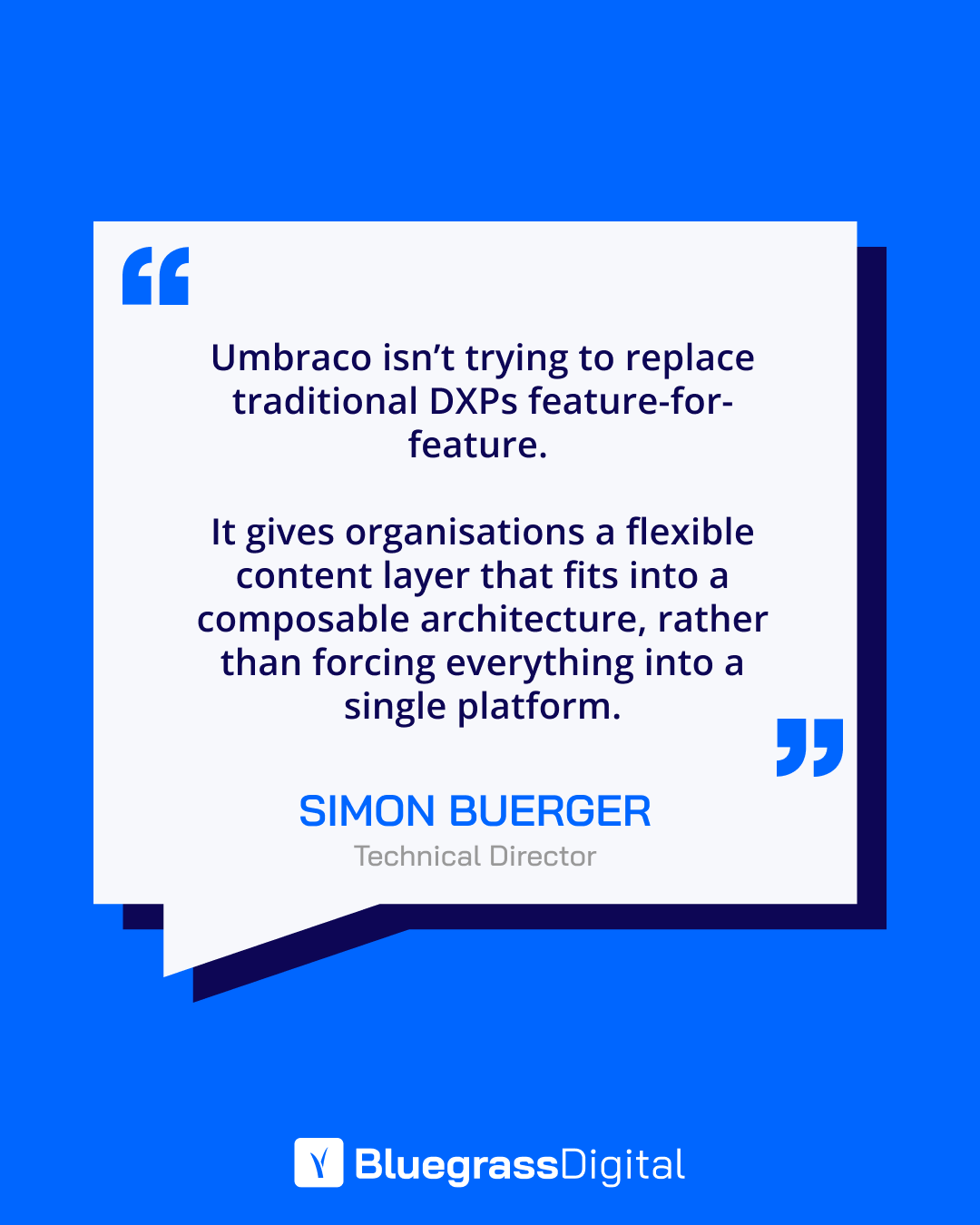
Its role is not to replace large experience suites, but to provide a flexible, extensible content foundation that integrates into composable digital architectures.
For organisations rethinking their CMS strategy, the decision is less about platform capability in isolation and more about how well it supports the broader digital ecosystem.
FAQ: Umbraco in Enterprise Replatforming
Is Umbraco suitable for enterprise websites?
Yes. Umbraco supports multi-site, multilingual content structures, role-based access control, workflow capabilities, and integration with enterprise systems via APIs.
Is Umbraco used in enterprise environments?
Yes. Umbraco is used across a range of enterprise and large-scale organisations, particularly where flexibility and composable architecture approaches are prioritised.
Can Umbraco support high-traffic websites?
Yes. Performance and scalability depend on architecture and hosting approach, with Umbraco commonly deployed in cloud environments such as Azure.
What is Umbraco Heartcore?
Umbraco Heartcore is a SaaS headless CMS offering that delivers content via APIs for use across websites, applications, and digital platforms.
Is Umbraco open source?
Yes. The core CMS is open source, with additional commercial offerings including Umbraco Cloud and Heartcore.
Does Umbraco support composable architecture?
Yes. Umbraco is commonly used as a content layer within composable architectures, integrating with best-of-breed enterprise systems.
What are the risks in migrating to Umbraco?
Risks are typically related to content modelling, SEO migration, and integration design rather than platform limitations.
Does migrating to Umbraco affect SEO?
SEO impact depends on migration execution. With correct redirect mapping, metadata migration, and content parity planning, rankings can be preserved.
Why are organisations moving to Umbraco?
Key drivers include reduced complexity, lower total cost of ownership, flexibility in architecture, and alignment with modern composable digital strategies.
Join the Discussion
In our upcoming webinar, we will explore what a successful replatforming journey actually looks like. From early planning through to delivery, including the architectural and strategic decisions that make the difference between a migration that simply goes live and one that delivers real value.
Webinar: Replatforming to Umbraco – A Practical Guide
?️ 23 April 2026; 14:00 SAST
