

AI Is Changing Experience Optimisation. Optimizely Is Already Building for What’s Next
AI experience optimisation is changing how businesses approach digital experiences. The question is no longer simply how AI can help teams generate ideas, content or recommendations, but how it can help them act on those insights.
That shift is becoming increasingly visible in the latest recognition for Optimizely, which has been named a Leader in The Forrester Wave™: Experience Optimization Solutions, Q3 2026, as well as a Customer Favorite based on customer feedback.
Forrester specifically highlights Optimizely’s focus on AI, including its Opal AI agentic orchestration layer, and its ability to support experimentation across web and feature experiences.
From recommendations to action
For years, experimentation has been about creating a hypothesis, setting up a test, analysing the results and deciding what to do next. AI has the potential to compress that cycle significantly.
Optimizely’s approach is moving towards AI that can help teams create and run experiments, rather than simply suggesting what they might test. That matters because the real value of AI in digital experience optimisation isn’t in producing more ideas. It’s in helping businesses learn faster and act on those learnings.
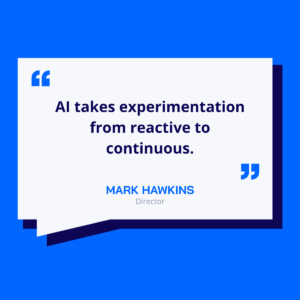
As Mark Hawkins, Director at Bluegrass Digital explains:
“AI is moving experience optimisation from a largely human-led cycle of analysing data, forming hypotheses and setting up experiments towards a more continuous process of testing, learning and adapting. The interesting part is what happens when AI can actually act on those insights.”
This is something we’re increasingly seeing in our own work with organisations using digital experience platforms. The technology is becoming more capable, but the challenge remains making sure it is connected to the right data, business goals and customer context.
AI still needs the right foundations
There is a tendency to talk about agentic AI as though the technology can simply be switched on and everything else follows.
In practice, the quality of the outcome depends heavily on what sits underneath it.
Good data. Clear goals. Well-structured content. A platform that can connect experiences, experimentation and customer insights. And, importantly, a team that understands how to turn those capabilities into something useful for the business.
That’s why developments like Optimizely’s are interesting to us. The opportunity isn’t just to add AI to an existing digital experience platform. It’s to rethink how optimisation itself happens.
The Forrester recognition is another signal that this is where the market is heading: towards digital experiences that can continuously learn, experiment and improve, with AI increasingly involved in the process.
For businesses, the question now is less “Should we be using AI?” and more “What could we achieve if our digital experiences could act on what they learn?”
Turning AI capabilities into better digital experiences
AI and experimentation can create significant opportunities for businesses, but getting value from them requires more than switching on a new platform capability.
At Bluegrass Digital, we help organisations design, build and evolve digital experiences using platforms including Optimizely. We bring together strategy, UX, development and technical expertise to make sure the technology supports real business and customer needs.
As AI becomes increasingly embedded in digital experience platforms, we help our clients understand where these capabilities can add genuine value, how they fit into their existing technology landscape and how to turn experimentation and insight into better experiences.
Exploring how AI and experience optimisation could work for your organisation? Get in touch with our team
