

What the Optimizely AEO Platform Signals About the Future of AI Discovery in DXPs
AI discovery is becoming a measurable layer inside digital experience platforms
Search is no longer the only system shaping how content is discovered.
Across enterprise digital ecosystems, AI systems are increasingly acting as intermediaries between users and content. They summarise, interpret, and recombine information before a user ever reaches a website. The recent launch of the Optimizely AEO platform highlights how quickly digital experience platforms are adapting to this shift.
Rather than treating AI discovery as an external trend, it is becoming embedded directly into the systems that power content, optimisation, and analytics.
This marks an important shift in how DXPs are evolving.
Not just as content management systems. But as AI-aware experience platforms.
From visibility in search to visibility in AI systems
Traditional SEO has always focused on ranking pages in search engines.
But AI-driven discovery behaves differently.
Instead of returning a list of links, AI systems increasingly generate direct answers based on multiple sources of content. This means brands are no longer only competing for rankings, but for inclusion and representation inside AI-generated responses.
The Optimizely AEO platform reflects this shift in focus.
According to Optimizely’s announcement, the platform brings together AI visibility tools, log-based AI traffic data, and optimisation agents designed to help marketers understand how their content is being interpreted by AI systems.
This moves the conversation from:
“How do we rank in search?”
to:
“How are AI systems interpreting and using our content?”
That distinction is becoming critical for digital teams.
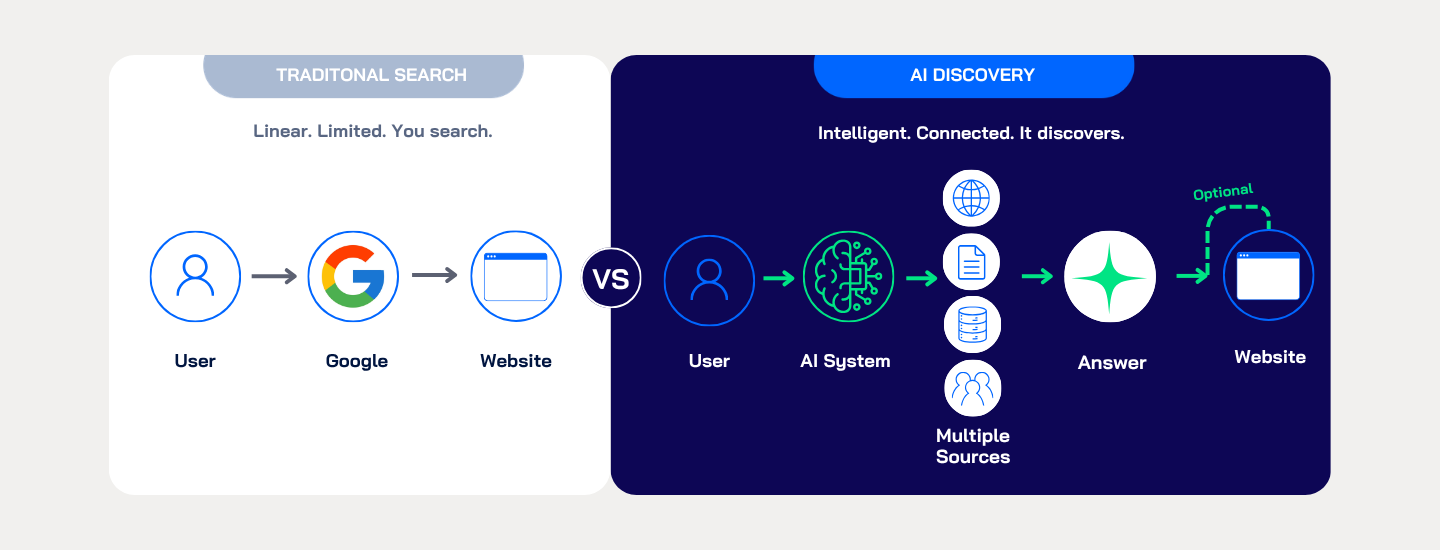
What Optimizely’s AEO platform introduces
The Optimizely AEO platform combines several capabilities into a unified system for AI-driven discovery. Based on the release, it includes:
- AI Visibility Analytics to understand how brands appear in AI-generated responses
- Log-based Agent Visibility Analytics to analyse how AI agents and crawlers interact with website content
- SEO, GEO and AEO intelligence through Optimizely’s partnership with Conductor
- AEO Gap Finding Agent to identify content gaps and prioritise optimisation opportunities
- Competitive AI Share of Voice Agent to benchmark AI visibility against competitors
- AI Brand Visibility Report Agent to monitor brand presence across major AI search platforms
- AI-powered optimisation workflows using Optimizely Opal to help teams move from insight to action
A key element of the platform is that it uses observed behaviour data rather than inferred signals.
This is significant because it allows teams to analyse actual AI agent interactions with content, not just estimated visibility.
It shifts AI discovery from a theoretical layer into something observable and measurable. Taken together, these capabilities bring AI visibility, content intelligence and optimisation into a single workflow, helping digital teams better understand how their content is discovered, interpreted and surfaced by AI systems.
The role of the Conductor partnership
A notable part of the announcement is Optimizely’s partnership with Conductor.
Conductor brings established search and content intelligence into the platform, including SEO and emerging AI visibility signals.
According to the release, this integration allows enterprise teams to combine:
- search performance data
- AI discovery signals
- content intelligence
- and visibility trends across multiple systems
This reflects a broader trend in the market. Rather than treating SEO, GEO, and AEO as separate disciplines, they are increasingly converging into a single visibility layer inside enterprise platforms.
Why agent-based optimisation matters
Another important development in the Optimizely AEO platform is the introduction of optimisation agents.
These agents are designed to act on insights generated from AI visibility data.
Examples include:
- identifying content gaps based on AI search behaviour
- benchmarking brand visibility against competitors in AI systems
- generating visibility reports with recommended next steps
- analysing share of voice across AI search environments
This represents a shift from analytics to execution.
Instead of only reporting on visibility, platforms are beginning to close the loop by helping teams act on it.
This is part of a wider move toward agent-based workflows inside DXPs, where optimisation becomes continuous rather than manual and periodic.
What this means for digital experience teams
The introduction of AI visibility and AEO capabilities inside platforms like Optimizely signals a broader change in how digital experience is being managed.
Three shifts stand out:
- Content is now evaluated by AI systems as well as humans
Content structure, clarity, and context now influence how AI systems interpret and reuse information.
- Visibility is becoming multi-layered
Brands need to understand performance not only in search engines, but also inside AI-generated responses and agent-based systems.
- Optimisation is becoming continuous
With agent-based systems, optimisation is moving from periodic updates to ongoing, automated improvement cycles.
These shifts are changing how teams think about content strategy, technical structure, and measurement.
The bigger picture: AI-driven discovery inside DXPs
What is most important about the Optimizely AEO platform is not any single feature.
It is the direction it represents.
Digital experience platforms are evolving from systems that deliver content to systems that actively participate in how content is discovered, interpreted, and optimised across AI environments.
In this model, content is no longer static once published.
It is continuously evaluated by both users and AI systems, with feedback loops that influence how it is surfaced in future interactions. This is where AI-driven discovery becomes a core part of the experience layer, not an external dependency.
Final thought
AI is not replacing search. But it is changing how discovery works across digital ecosystems.
The Optimizely AEO platform is an early signal of how DXPs are adapting to this reality by combining AI visibility, content intelligence, and automated optimisation into a single system.
For digital teams, the focus is shifting from publishing content to understanding how that content is interpreted, surfaced, and recomposed across AI-driven environments.
In practice: What this means for digital teams
The introduction of AI visibility and agent-based optimisation is another example of how digital experience platforms are evolving beyond traditional content management.
As organisations begin to consider how AI-driven discovery fits into their digital strategy, the challenge is no longer simply creating more content. It is understanding how that content is structured, interpreted, measured, and continuously improved across both search engines and AI-powered experiences.
At Bluegrass Digital, we work with organisations using Optimizely to design, build, and optimise digital experiences that are ready for this next phase of platform evolution. As these capabilities continue to mature, our focus remains the same: helping clients apply new technology in ways that deliver measurable business value.
